
NHTSA ID Number: 10161925
Manufacturer Communication Number: 19NA114
Summary
This informational bulletin provides information to the tech to test the PCV for proper performance before replacing the camshaft cover to correct a MIL On w/DTC P0171.
36 Affected Products
Vehicles
| MAKE | MODEL | YEAR |
BUICK | ENCORE | 2013-2019 |
| CADILLAC | ELR | 2014-2017 |
| CHEVROLET | CRUZE | 2011-2016 |
| CHEVROLET | SONIC | 2012-2019 |
| CHEVROLET | TRAX | 2013-2019 |
| CHEVROLET | VOLT | 2012-2015 |
Condition
MIL is illuminated.
DTC P0171 (Fuel Trim System Lean) or other airflow related codes set in the Engine Control Module (ECM).
Cause
This condition may be caused by a torn positive crankcase ventilation (PCV) Crankcase Pressure Control Diaphragm.
⇒ The PCV crankcase pressure control diaphragm in the PCV valve could be torn, allowing un-metered air to enter the crankcase.
Information
Following the diagnostics in SI for that DTC may lead to the PCV system as a potential source of external airflow.
Confirmation of the PCV valve performance must be done before replacing the camshaft cover.
1 Associated Document
Manufacturer Communications
Bulletin No.: 19-NA-114
Date: May, 2019
NHTSA ID Number: 10161902
Manufacturer Communication Number: 19NA114
Summary
This informational bulletin provides information to the tech to test the PCV for proper performance before replacing the camshaft cover to correct a MIL On w/DTC P0171.
1 Associated Document
Manufacturer Communications
Bulletin No.: 19-NA-114
Date: May, 2019
NHTSA ID Number: 10149063
Manufacturer Communication Number: PIP5197J
Summary
This Preliminary Information communication provides information to the technician on the steps to diagnose and repair vehicles that have excessive oil consumption, blue smoke from the exhaust, or a Malfunction Indicator Lamp. Technician should inspect the PVC orifice for leaking oil or drawing a vacuum at idle. If the PCV orifice external port is leaking oil or vacuum, replace the camshaft cover assembly. Technician will inspect for a missing intake manifold Non Return Valve that may have damaged the PCV orifice diaphragm. Check for the return valve if it is not visible use a long cotton swab to wipe any excess oil from the valve to validate. If the non return valve is still not visible, then intake manifold removal for inspection is required to validate. When the valve is present reinstall the intake manifold. When the valve is not present replace the intake manifold assembly.
1 Associated Document
Manufacturer Communications
Bulletin No.: PIP5197J
Published date: 10/30/2018
MC-10149063-9999.pdf 2882.673KB
NHTSA ID Number: 10147383
Manufacturer Communication Number: PIP5197H
Summary
This Preliminary Information communication provides information to the technician on the steps to diagnose and repair vehicles that have excessive oil consumption, blue smoke from the exhaust, or a Malfunction Indicator Lamp. Technician should inspect the PVC orifice for leaking oil or drawing a vacuum at idle. If the PCV orifice external port is leaking oil or vacuum, replace the camshaft cover assembly. Technician will inspect for a missing intake manifold Non Return Valve that may have damaged the PCV orifice diaphragm. Check for the return valve if it is not visible use a long cotton swab to wipe any excess oil from the valve to validate. If the non return valve is still not visible, then intake manifold removal for inspection is required to validate. When the valve is present reinstall the intake manifold. When the valve is not present replace the intake manifold assembly.
1 Associated Document
Manufacturer Communications
Bulletin No.: PIP5197H
Published date: N/A
MC-10147383-9999.pdf 2882.651KB
NHTSA ID Number: 10137185
Manufacturer Communication Number: PIP5197G
Summary
This Preliminary Information communication provides information to the technician on the steps to diagnose and repair vehicles that have excessive oil consumption, blue smoke from the exhaust, or a Malfunction Indicator Lamp. Technician should inspect the PVC orifice for leaking oil or drawing a vacuum at idle. If the PCV orifice external port is leaking oil or vacuum, replace the camshaft cover assembly. Technician will inspect for a missing intake manifold Non Return Valve that may have damaged the PCV orifice diaphragm. Check for the return valve if it is not visible use a long cotton swab to wipe any excess oil from the valve to validate. If the non return valve is still not visible, then intake manifold removal for inspection is required to validate. When the valve is present reinstall the intake manifold. When the valve is not present replace the intake manifold assembly.
1 Associated Document
Manufacturer Communications
Bulletin No.: PIP5197G
Published date: 03/13/2018
NHTSA ID Number: 10113857
Manufacturer Communication Number: PIP5197E
Summary
This Preliminary Information communication provides information to the technician on the steps to diagnose and repair vehicles that have excessive oil consumption, blue smoke from the exhaust, or a Malfunction Indicator Lamp. Technician should inspect the PVC orifice for leaking oil or drawing a vacuum at idle. If the PCV orifice external port is leaking oil or vacuum, replace the camshaft cover assembly. Technician will inspect for a missing intake manifold Non Return Valve that may have damaged the PCV orifice diaphragm. Check for the return valve if it is not visible use a long cotton swab to wipe any excess oil from the valve to validate. If the non return valve is still not visible, then intake manifold removal for inspection is required to validate. When the valve is present reinstall the intake manifold. When the valve is not present replace the intake manifold assembly.
1 Associated Document
Manufacturer Communications
Bulletin No.: PIP5197E
Published date: 04/4/2017
MC-10113857-9999.pdf 548.906KB
NHTSA ID Number: 10114424
Manufacturer Communication Number: PIP5197B
Summary
This Preliminary Information communication provides information to the technician on the steps to diagnose and repair vehicles that have excessive oil consumption, blue smoke from the exhaust, or a Malfunction Indicator Lamp. Technician should inspect the PVC orifice for leaking oil or drawing a vacuum at idle. If the PCV orifice external port is leaking oil or vacuum, replace the camshaft cover assembly. Technician will inspect for a missing intake manifold Non Return Valve that may have damaged the PCV orifice diaphragm. Check for the return valve if it is not visible use a long cotton swab to wipe any excess oil from the valve to validate. If the non return valve is still not visible, then intake manifold removal for inspection is required to validate. When the valve is present reinstall the intake manifold. When the valve is not present replace the intake manifold assembly.
1 Associated Document
Manufacturer Communications
Bulletin No.: PIP5197B
Date: Feb-2015
MC-10114424-9999.pdf 1155.486KB
NHTSA ID Number: 10114390
Manufacturer Communication Number: PIP5197A
Summary
This Preliminary Information communication provides information to the technician on the steps to diagnose and repair vehicles that have excessive oil consumption, blue smoke from the exhaust, or a Malfunction Indicator Lamp. Technician should inspect the PVC orifice for leaking oil or drawing a vacuum at idle. If the PCV orifice external port is leaking oil or vacuum, replace the camshaft cover assembly. Technician will inspect for a missing intake manifold Non Return Valve that may have damaged the PCV orifice diaphragm. Check for the return valve if it is not visible use a long cotton swab to wipe any excess oil from the valve to validate. If the non return valve is still not visible, then intake manifold removal for inspection is required to validate. When the valve is present reinstall the intake manifold. When the valve is not present replace the intake manifold assembly.
1 Associated Document
Manufacturer Communications
Bulletin No.: PIP5197A
Date: Feb-2015
MC-10114390-9999.pdf 1155.973KB
NHTSA ID Number: 10112056
Manufacturer Communication Number: PIP5197
Summary
This Preliminary Information communication provides information to the technician on the steps to diagnose and repair vehicles that have excessive oil consumption, blue smoke from the exhaust, or a Malfunction Indicator Lamp. Technician should inspect the PVC orifice for leaking oil or drawing a vacuum at idle. If the PCV orifice external port is leaking oil or vacuum, replace the camshaft cover assembly. Technician will inspect for a missing intake manifold Non Return Valve that may have damaged the PCV orifice diaphragm. Check for the return valve if it is not visible use a long cotton swab to wipe any excess oil from the valve to validate. If the non return valve is still not visible, then intake manifold removal for inspection is required to validate. When the valve is present reinstall the intake manifold. When the valve is not present replace the intake manifold assembly.
1 Associated Document
Manufacturer Communications
Bulletin No.: PIP5197
Date: May-2014
MC-10112056-9999.pdf 1385.25KB
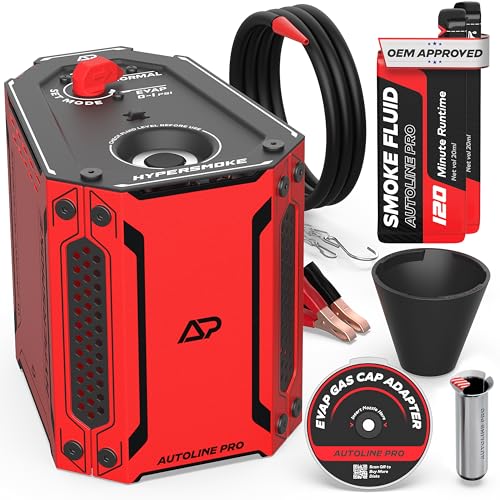
- HyperSmoke Technology – Creates Thick Visible Smoke for Easy Leak Testing. Adjustable Pressure. Infinite Smoke. Instant Warmup. Built-In Air Compressor Motor. OEM Approved Smoke Fluid. Designed and Engineered by AutoLine Pro USA, an American Team of Individuals bringing the latest innovation to you.
- HyperSmoke Benefits – Hypersmoke never overheats, has EVAP mode to protect EVAP from permanent damage, has a mode with higher pressure to test for more leaks like boost/turbo, has a built-in air compressor, comes with proper automotive-grade leak detection fluid for safe and accurate testing, engineered in the USA with custom components and is a professional-grade tool made for serious diagnostic work.
- Includes Everything You Need – Made for ALL Leak Testing Scenarios - EVAP, Vacuum, Intake, Exhaust, Turbo, Superchargers, EGR, Cooling Systems, Engine Blocks, Oil Leaks, Body Work, Wind & Water Leaks, worn rubber, gaskets, seals, connectors, Cars, Trucks, Tractors, Semis, Motorcycles, Scientific Apparatus, and more!
- OEM Approved Smoke Fluid Included – Safe for all systems and sensors. Premium High-Smoke output formula. We’ve included plenty of fluid so you can focus on what’s important – 240 minutes of runtime!
- Adjustable Pressure – Adjustable Pressure gives you the flexibility to leak test a significantly wider array of systems ranging from EVAP all the way to Turbocharged systems. Why is this feature important? EVAP must be tested at under 1 PSI otherwise DAMAGE WILL OCCUR. This is a feature MISSING from other overseas copy-paste smoke machines.
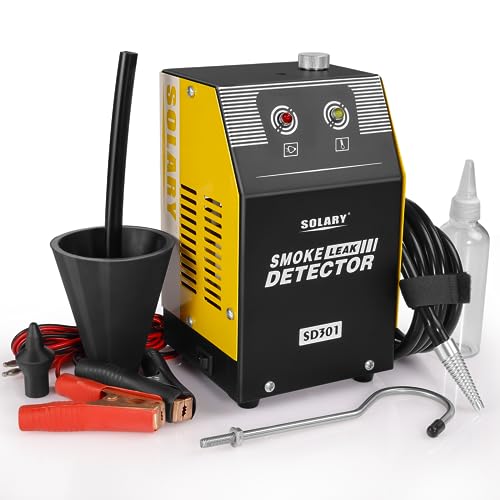
- [Built-in Air Pump]: Smoke machine features a built-in air pump, eliminating the need for an external air source, allowing you to perform tests anytime, anywhere. Simply add about 20ml of baby oil or Glycerin (oil not included) to start your testing effortlessly
- [Multi-Function]: Suitable for a wide range of tests, including EVAP systems, vacuum leaks, low-pressure turbo leaks, intake manifolds, cooling/EGR/exhaust systems, and more. It can be used on cars, motorcycles, and various other vehicles
- [Quick Detection]: The machine generates thick smoke within just 10 seconds of startup, providing enough output to detect even the smallest leaks, ensuring fast and accurate problem identification
- [Lightweight and Portable]: Weighing only 4.4lb, the Solary automotive smoke machine is compact, easy to store, and transport, making it an essential tool for every car owner
- [User-Friendly]: With a simple and intuitive interface, the device has a low entry barrier, making it easy for even first-time users to quickly get started
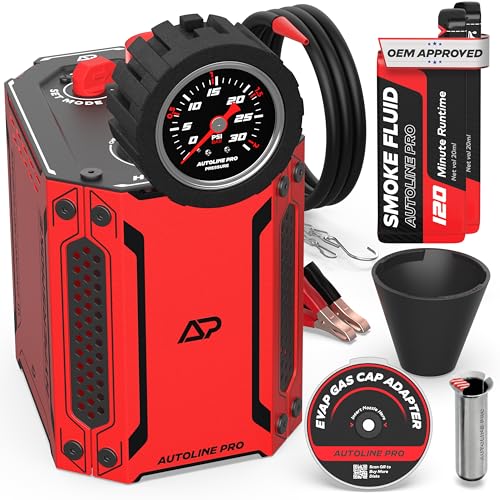
- HyperSmoke Technology – Creates Thick Visible Smoke for Easy Leak Testing. Adjustable Pressure. Infinite Smoke. Instant Warmup. Built-In Air Compressor Motor. OEM Approved Smoke Fluid. Designed and Engineered by AutoLine Pro USA, an American Team of Individuals bringing the latest innovation to you.
- HyperSmoke Benefits – Hypersmoke never overheats, has EVAP mode to protect EVAP from permanent damage, has a mode with higher pressure to test for more leaks like boost/turbo, has a built-in air compressor, comes with proper automotive-grade leak detection fluid for safe and accurate testing, engineered in the USA with custom components and is a professional-grade tool made for serious diagnostic work.
- Includes Everything You Need – Made for ALL Leak Testing Scenarios - EVAP, Vacuum, Intake, Exhaust, Turbo, Superchargers, EGR, Cooling Systems, Engine Blocks, Oil Leaks, Body Work, Wind & Water Leaks, worn rubber, gaskets, seals, connectors, Cars, Trucks, Tractors, Semis, Motorcycles, Scientific Apparatus, and more!
- OEM Approved Smoke Fluid Included – Safe for all systems and sensors. Premium High-Smoke output formula. We’ve included plenty of fluid so you can focus on what’s important – 240 minutes of runtime!
- Adjustable Pressure – Adjustable Pressure gives you the flexibility to leak test a significantly wider array of systems ranging from EVAP all the way to Turbocharged systems. Why is this feature important? EVAP must be tested at under 1 PSI otherwise DAMAGE WILL OCCUR. This is a feature MISSING from other overseas copy-paste smoke machines.

- HyperSmoke Technology – Creates Thick Visible Smoke for Easy Leak Testing. Adjustable Pressure. Infinite Smoke. Instant Warmup. Built-In Air Compressor Motor. OEM Approved Smoke Fluid. Designed and Engineered by AutoLine Pro USA, an American Team of Individuals bringing the latest innovation to you.
- HyperSmoke Benefits – Hypersmoke never overheats, has EVAP mode to protect EVAP from permanent damage, has a mode with higher pressure to test for more leaks like boost/turbo, has a built-in air compressor, comes with proper automotive-grade leak detection fluid for safe and accurate testing, engineered in the USA with custom components and is a professional-grade tool made for serious diagnostic work.
- Includes Everything You Need – Made for ALL Leak Testing Scenarios - EVAP, Vacuum, Intake, Exhaust, Turbo, Superchargers, EGR, Cooling Systems, Engine Blocks, Oil Leaks, Body Work, Wind & Water Leaks, worn rubber, gaskets, seals, connectors, Cars, Trucks, Tractors, Semis, Motorcycles, Scientific Apparatus, and more!
- OEM Approved Smoke Fluid Included – Safe for all systems and sensors. Premium High-Smoke output formula. We’ve included plenty of fluid so you can focus on what’s important – 240 minutes of runtime!
- Adjustable Pressure – Adjustable Pressure gives you the flexibility to leak test a significantly wider array of systems ranging from EVAP all the way to Turbocharged systems. Why is this feature important? EVAP must be tested at under 1 PSI otherwise DAMAGE WILL OCCUR. This is a feature MISSING from other overseas copy-paste smoke machines.
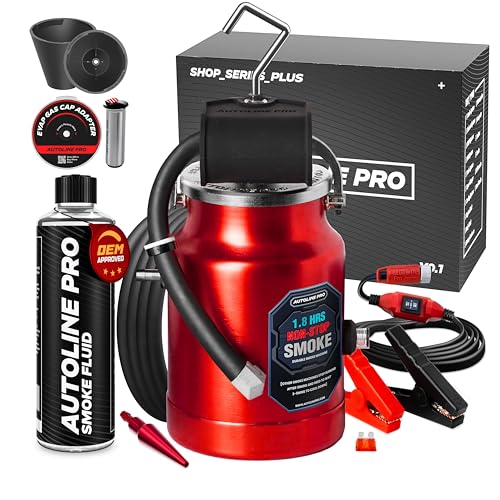
- NEW BUILT-IN AIR MOTOR: No need for a separate air supply!
- HIGH PERFORMANCE, PREMIUM BUILD: Made in the USA. Solid Thick Metal Construction for durability. Equipped with our brand new AutoLine Pro Ceramic Smoke Coil and Top Rated Smoke Fluid that outputs LOTS OF SMOKE and last a Lifetime.
- PRECISE AND SAFE: Engineered to be 100% safe for all vehicles. Thick smoke output detects even the smallest leaks. A perfect complement to tools such as Fuel Pressure Testers when diagnosing EVAP and fuel-related systems.
- SIMPLE TO USE: (1) Fill with the included OEM Approved or Any Smoke Fluid. (2) Turn on the Built-In Air Motor. (3) Start smoke diagnostics!
- OEM APPROVED SMOKE FLUID INCLUDED: Safe for all systems and sensors. 800 Min Premium High-Smoke output formula. We’ve included plenty of fluid so you can focus on what’s important. ( Other brand's smoke machine just comes with EMPTY bottle)
SEOCONTENT-START
Copyright 2019 General Motors LLC. All Rights Reserved. Service Bulletin Bulletin No.: 19-NA-114 Date: May, 2019 INFORMATION Subject: Information on Malfunction Indicator Lamp (MIL) Illuminated – DTC P0171 Set This Bulletin replaces PIP5197M. Please discard PIP5197M. Brand: Model: Model Year: VIN: Engine: Transmission: from to from to Buick Encore 2013 2019 1.4L (LUJ, LUU, LUV) Cadillac ELR 2014 2017 Chevrolet Cruze 2011 2016 Sonic 2012 2019 Trax 2013 2019 Volt 2012 2015 Involved Region or Country North America Condition Some customers may comment that the MIL is illuminated. Some technicians may find DTC P0171 (Fuel Trim System Lean) or other airflow related codes set in the Engine Control Module (ECM). Cause This condition may be caused by a torn positive crankcase ventilation (PCV) Crankcase Pressure Control Diaphragm. ⇒ The PCV crankcase pressure control diaphragm in the PCV valve could be torn, allowing un-metered air to enter the crankcase. Information Following the diagnostics in SI for that DTC may lead to the PCV system as a potential source of external airflow. Confirmation of the PCV valve performance must be done before replacing the camshaft cover. Page 2 May, 2019 Bulletin No.: 19-NA-114 Service Procedure 5335015 Test to confirm a tear in the PCV valve: 1. Remove the engine cover. Refer to Engine Cover Replacement in SI. 2. Verify that the engine oil dipstick is fully seated, and the oil fill cap is fully tightened. 3. With the engine running, listen for noise coming from the PCV valve. ⇒ If noise is heard, check to see if the noise gets quieter or disappears with the engine oil dipstick removed. 4. Reinsert the dipstick. Note: Normal operation of the PCV crankcase pressure control diaphragm could cause a tissue to flutter against the port (smoke would not be continuously drawn into the port). A torn crankcase pressure control diaphragm would cause the tissue to be held against the port (smoke would be continuously drawn in) due to internal engine vacuum leaking through the diaphragm. 5. Check to see if there is vacuum at the PCV vent at the front of the PCV valve by placing a piece of tissue near it. ⇒ The tissue will be sucked against the vent and held if vacuum is present. Smoke can also be used to see if it is drawing into the PCV vent port. • If the PCV valve is making noise and there is vacuum present at the PCV valve vent, replace the camshaft cover. Refer to Camshaft Cover Replacement in SI. • If the PCV valve does NOT make noise or leak vacuum, the PCV system is not the cause and further diagnostics using SI would be needed. 6. Reinstall the engine cover. Refer to Engine Cover Replacement in SI. Version 1 Modified Released May 15, 2019
SEOCONTENT-END
This product presentation was made with AAWP plugin.
Is there a similar problem on 2012 sonics with the 1.4l? The PCV valve is leaking and the non-return valve is not visible upon inspection. Can these repair procedures be applied to my sonic?
What if I already had this replaced before and the problem showed up a year and a half later?