
NHTSA ID Number: 10113594
Manufacturer Communication Number: PI0421D
Summary
This preliminary informational bulletin provides repair information to correct a customer concern of a fluid leak from under the front of the vehicle, the clutch pedal is hard to push, returns slow, does not return all the way to the top or does not return at all.
9 Affected Products
Vehicles
SEOCONTENT-START
Bulletin No.: PI0421D
Date: Apr-2015
| Subject: | Fluid Leak after Clutch Actuator Replacement |
| Models: | 2011-2015 Chevrolet Cruze Cruze |
| 2012-2015 Chevrolet Sonic |
|
| Equipped with Manual Transmission |
This PI has been revised to update the Model Years and Warranty Information. Please discard PI0421C.
Condition/Concern
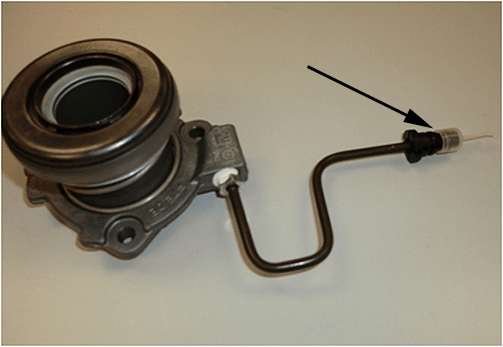
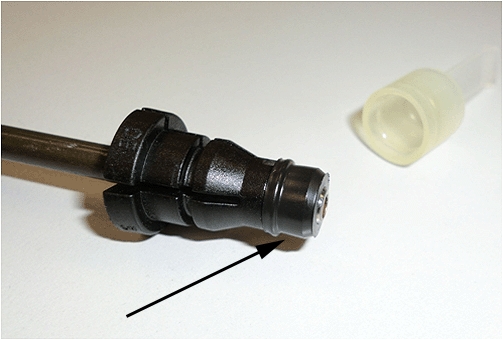
Some customers may comment on a fluid leak from under the front of the vehicle, the clutch pedal is hard to push, returns slow, does not return all the way to the top or does not return at all.
Technicians may also notice the clutch pedal is hard to bleed or clutch slave cylinder seal fails after 3-4 clutch pedal pumps and a fluid leak is observed from the clutch actuator cylinder pipe elbow after the clutch actuator cylinder replacement. The condition may be present as soon as the repair is completed or may surface within 1,600 km (1,000 mi) of repair. The vehicle may also have a repeat clutch performance concern such as slip or high shift effort and clash.
Further inspection may reveal that the leak is brake fluid coming from the clutch actuator cylinder pipe elbow.
After replacement of the clutch actuator cylinder, the seal from the clutch actuator cylinder pipe may be retained in the pipe elbow. The new clutch actuator cylinder has a new seal attached to the pipe and if the old seal is not removed, it can cause a poor seal allowing fluid to leak. It can also cause a blockage in the pipe restricting flow into or out of the clutch actuator cylinder. If the seal is in the right position, fluid will enter the clutch actuator cylinder but does not exhaust and after 3-4 clutch cycles, the cylinder over strokes and the seal fails. The seal can also block the line where the clutch cylinder will not stroke and the pedal will feel hard.
Recommendation/Instructions
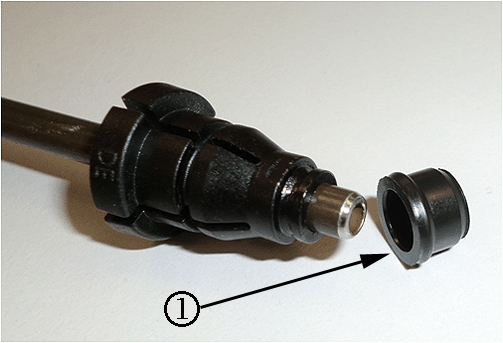
Remove the old seal from the clutch actuator cylinder elbow pipe following the procedure below.
- Raise the vehicle.
- Disconnect the clutch actuator cylinder elbow pipe and remove the old seal (1).
- Connect the clutch actuator cylinder elbow pipe. Make sure there is only one seal in place.
- Lower the vehicle.
Warranty Information
For vehicles repaired under the Bumper-to-Bumper coverage (Canada Base Warranty coverage), use the following labor operation. Reference the Applicable Warranties section of Investigate Vehicle History (IVH) for coverage information.
| Labor Operation |
Description | Labor Time |
| 8480248* | Remove Clutch Actuator Cylinder Elbow Seal | 0.3 hr |
| *This is a unique Labor Operation for Bulletin use only. It will not be published in the Labor Time Guide. | ||
SEOCONTENT-END
Bulletin No.: PI0421D
Date: Apr-2015
To View or Download this Document Click Here
Bulletin No.: PI0421C
Date: Nov-2012
To View or Download this Document Click Here
Bulletin No.: PI0421C
Date: Nov-2012
To View or Download this Document Click Here
Bulletin No.: PI0421C
Date: Nov-2012
To View or Download this Document Click Here
NHTSA ID Number: 10098702
Manufacturer Communication Number: PI0421C
Bulletin No.: PI0421C
Date: December, 2012
To View or Download this Document Click Here

- Mixes well with conventional fluids
- Low-moisture formula provides excellent vapor lock protection
- Ideal for hydraulic and disc brakes

- Ideal for hydraulic and disc brakes
- Mixes well with conventional fluids
- Low-moisture formula provides excellent vapor lock protection

- Provides an extra margin of safety in extreme braking conditions (packaging may vary)
- Mix of polyglycol ethers ensures hot brake-system operation will not create dangerous vapor
- Excellent for ABS, disc and drum brake systems
- Delivers braking power when needed by avoiding a spongy pedal
- Both wet and dry boiling points exceed the minimum government standards

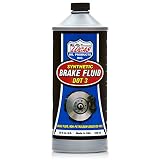
- Exceeds DOT 3 regulations: Formulated to meet or surpass DOT 3 requirements, ensuring consistent braking performance and dependable stopping power in all conditions
- Premium high boiling point: Helps prevent vapor lock and brake fade under extreme heat, maintaining safe and reliable braking even in demanding situations
- Full synthetic formula: Provides superior resistance to moisture absorption and corrosion, helping protect vital brake system components for long-lasting performance
- Superior protection and performance: Designed to deliver reliable braking under extreme temperatures while supporting the safety and efficiency of the braking system
- Recommended applications: Suitable for ABS, disc, and drum brake systems; surpasses SAE J1703, FMVSS 116, and ISO 4925 DOT 3 specifications
This product presentation was made with AAWP plugin.
I am also having the same issue now, 4 release bearing changed .what to do.
What if its still leaking brake fluid after all this and its been Repeated on 3 different slaves?? Every time its put back together an gets some pressure built up the seal.blows an it starts pouring brake fluid from the bottom of the trans. My car has been down almost 2 months because of this problem an 2 shops told me they can’t figure it out. I’ve dome replaced the whole clutch an bought 2 other slaves after I bought the clutch kit. Someone please help Me out.
im currently having same issue please let me know if you figure it out
bryan s
I replaced new clutch and when taking air bearing get leaked some one help me.this is 3rd bearing
pls u find the problems